

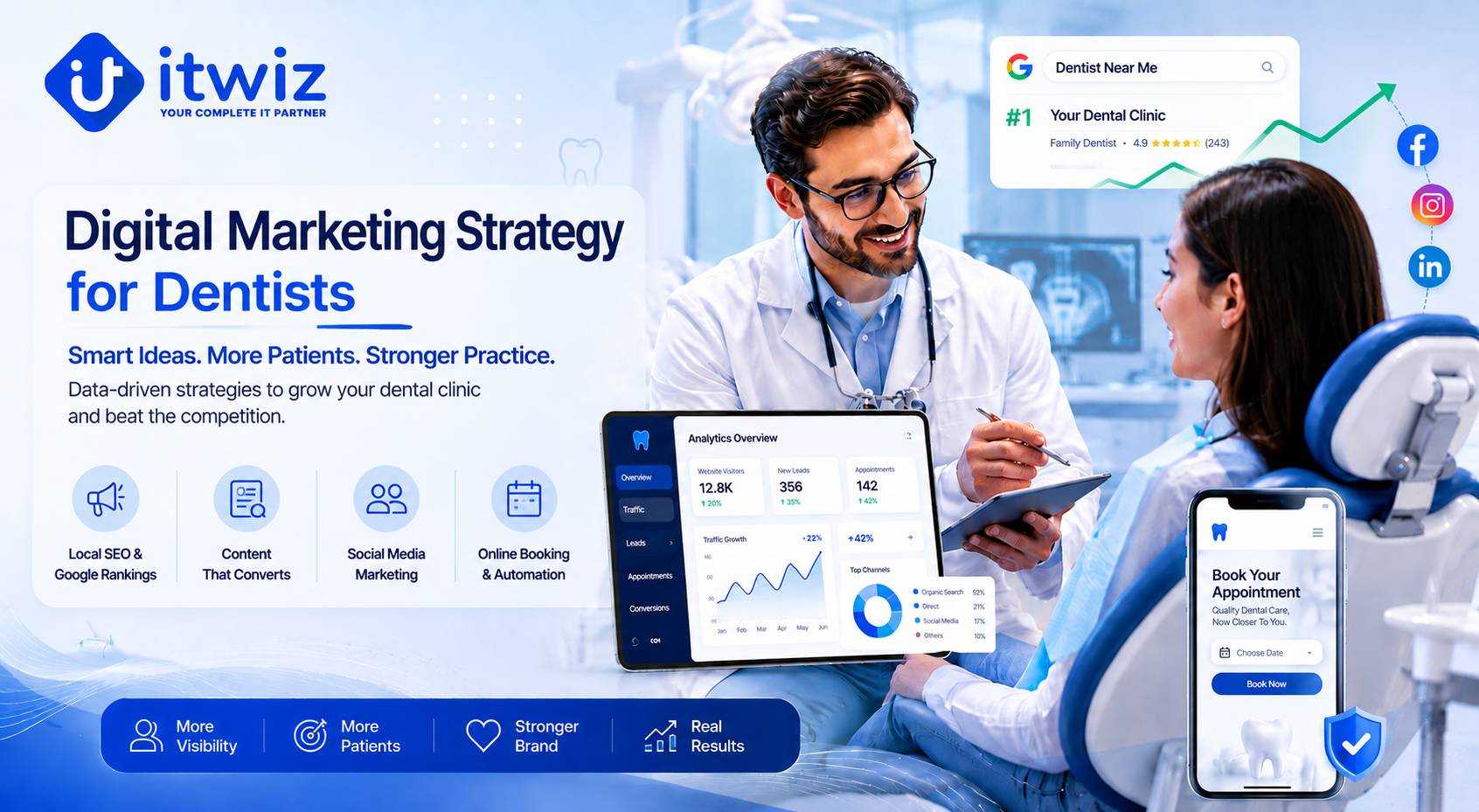
Most dentists who come to us with a marketing problem assume the issue is budget. More ads, more Instagram posts, more content. In almost every case, that is the wrong diagnosis.
The real problem is usually one of three things: patients are searching for dental care in the area and the clinic is not appearing. Or it is appearing, but the online presence does not give patients enough confidence to make contact. Or patients do reach out, and the follow-up is slow enough that they have already booked elsewhere by the time someone responds.
This guide covers every pillar of digital marketing for dentists — local SEO, Google Business Profile, website structure, content, paid media, reputation, social media, and patient conversion — in the order that actually produces results.
Why Digital Marketing Matters for Dentists Today
How Patient Behaviour Has Changed
By the way, a patient with a cracked molar on a friday evening isn't asking a neighbour for a recommendation. They open Google/Chatgpt and search 'dentist open Saturday near me,' compare the top three results in the local pack, check the star ratings, and decide in under five minutes. BrightLocal's 2023 research found that 87 percent of consumers use Google to evaluate local businesses with healthcare included. Even patients referred by word of mouth will look up a clinic online before confirming.
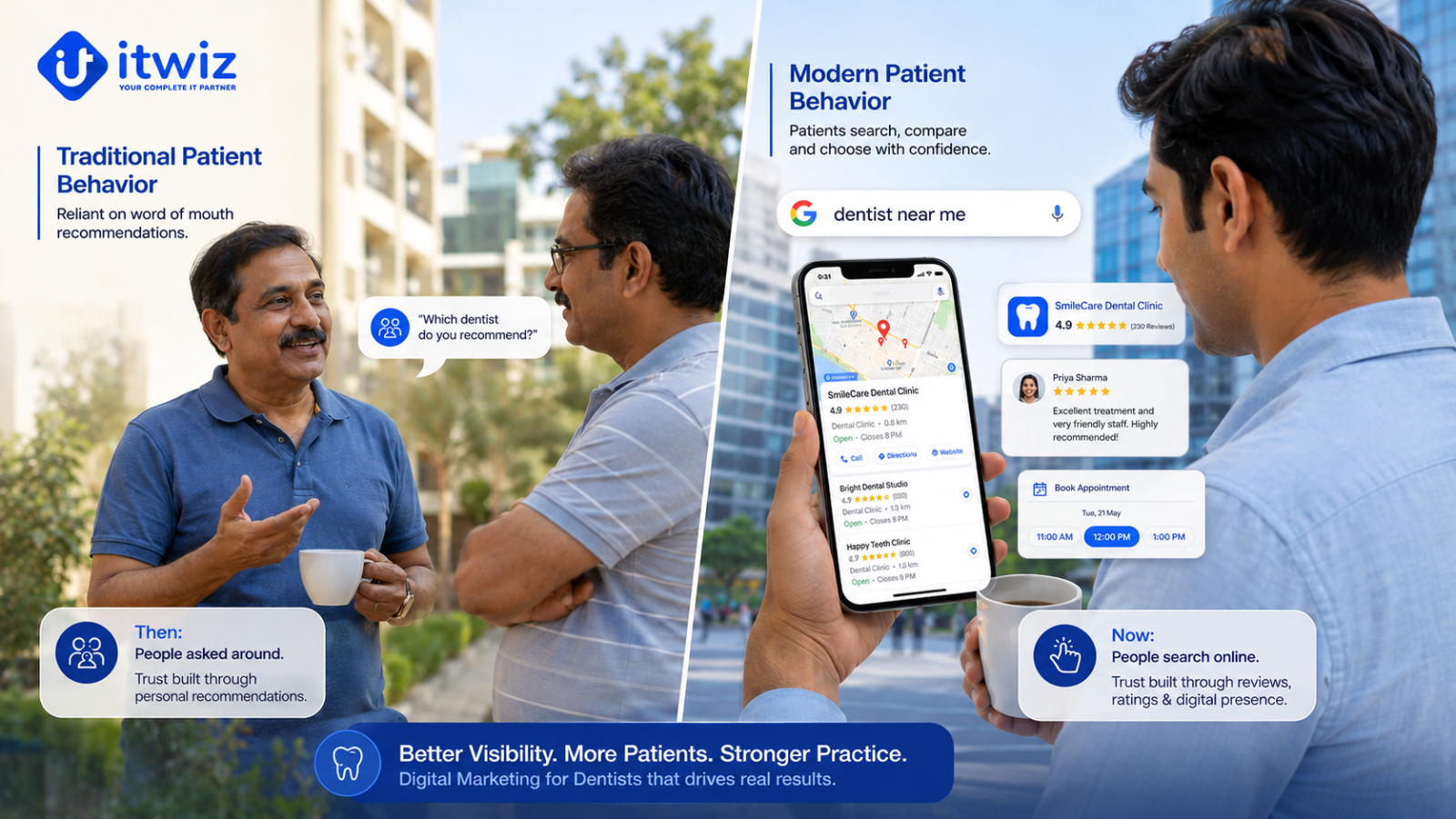
How Online Presence Shapes Trust
By the time someone calls your clinic, they've already decided what they think. They've read your reviews, checked out your profile, made sure your website loads on their phone. That phone call isn't first impressions — it's just the confirmation. A dated website with few reviews communicates inattention. Inconsistencies a wrong phone number on Justdial, a Practo profile last updated in 2020 , creates doubt that patients rarely verbalise but reliably act on subconsciously.
Visibility Is Not the Same as Bookings
Many clinics rank in local search but still struggle to convert visitors into patients. We regularly audit clinics that appear in the top three Google results for their primary keyword and receive almost no calls from it. They have the traffic; they are not capturing it. Visibility and conversion are separate problems, and fixing one without the other produces very little.
WHAT YOUR DENTAL MARKETING STRATEGY ACTUALLY NEEDS IS A PLAN
Strong positioning helps your dental clinic stand out online. Clinics known for a specific service, such as braces, implants, or cosmetic dentistry, often attract more targeted patients than clinics promoting everything equally.
For example, a clinic in South Kolkata recognized for orthodontic treatments is more likely to attract patients searching for braces. Positioning is not about offering fewer services—it is about becoming known for what you do best.
WAYS TO BUILD STRONG ONLINE PRESENCE FOR YOUR CLINIC
You need to know who you are TARGETTING
Dental care is a highly local business. Most patients prefer visiting a clinic that is close to their home or workplace, especially for routine treatments such as cleanings, fillings, and regular check-ups. In most cases, patients are unlikely to travel more than 5–7 kilometers for these services.
However, for procedures such as dental implants, smile makeovers, or full-mouth rehabilitation. Patients are often willing to travel longer distances when they are looking for expertise, advanced technology, or a trusted specialist.
This is why understanding your target market is essential. A focused approach ensures your clinic reaches the patients who are most likely to choose and recommend your services.
Set clear and measurable GOALS
Successful practice growth requires clearly defined objectives rather than broad ambitions such as “acquiring more patients.” Establishing measurable targets allows clinics to evaluate performance and make informed decisions.
For example, a clinic may aim to generate 15 enquiries from Google each month, maintain a cost per lead below ₹400, and convert 40% of consultations into treatment cases. These metrics provide a clear framework for monitoring results and identifying areas for improvement.
By setting specific, data-driven goals, dental practices can accurately assess the effectiveness of their marketing efforts and optimize their strategies over time. Without measurable benchmarks, it becomes difficult to evaluate success or identify opportunities for growth.
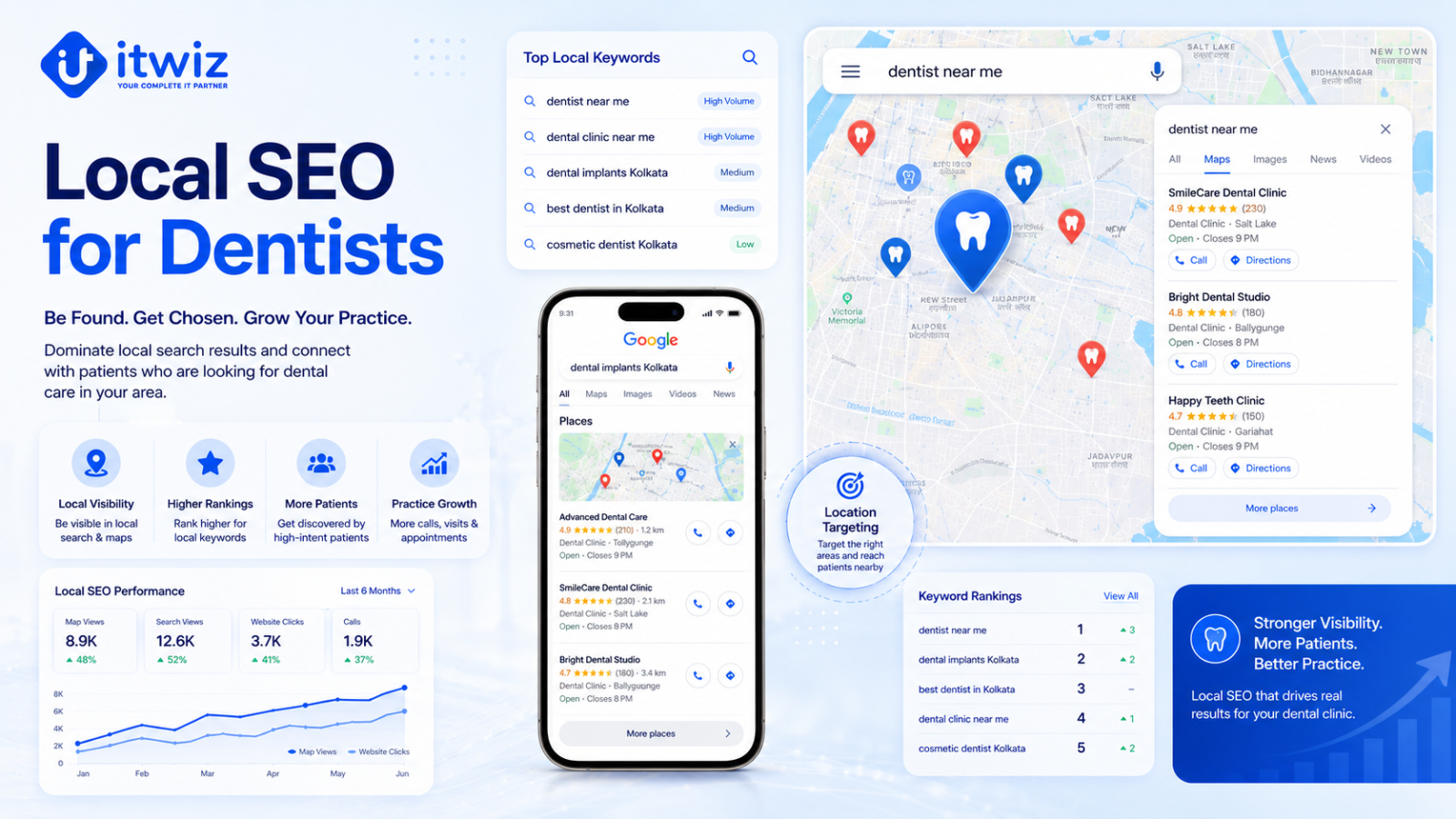
Optimize Your Clinic for Local Search
Local SEO plays a crucial role in helping dental clinics attract new patients. People who search for dental services online are often actively looking for treatment, making them highly valuable potential patients.
To improve local search visibility, your website should
-
Include your clinic’s location in website titles, headings, and content.
-
Create dedicated pages for the areas you serve with unique content and a clear call to action.
-
Target location-based keywords that potential patients are likely to search for.
-
Use Google Search Console to identify and expand on relevant search opportunities.
-
Ensure your clinic’s name, address, and phone number are consistent across all online platforms.
Regularly audit your online listings to ensure your clinic’s information remains consistent across all platforms, and review them at least every six months.
Build Authority and Strengthen Local Visibility
Earning backlinks from trusted sources such as healthcare publications, hospitals, and business associations can improve your clinic’s search rankings and online credibility. Even a few high-quality local links each year can help build authority over time.
In addition, a well-optimized Google Business Profile can significantly improve local visibility. Regularly updating your profile with accurate information, photos, services, and patient reviews can help attract more local patients.
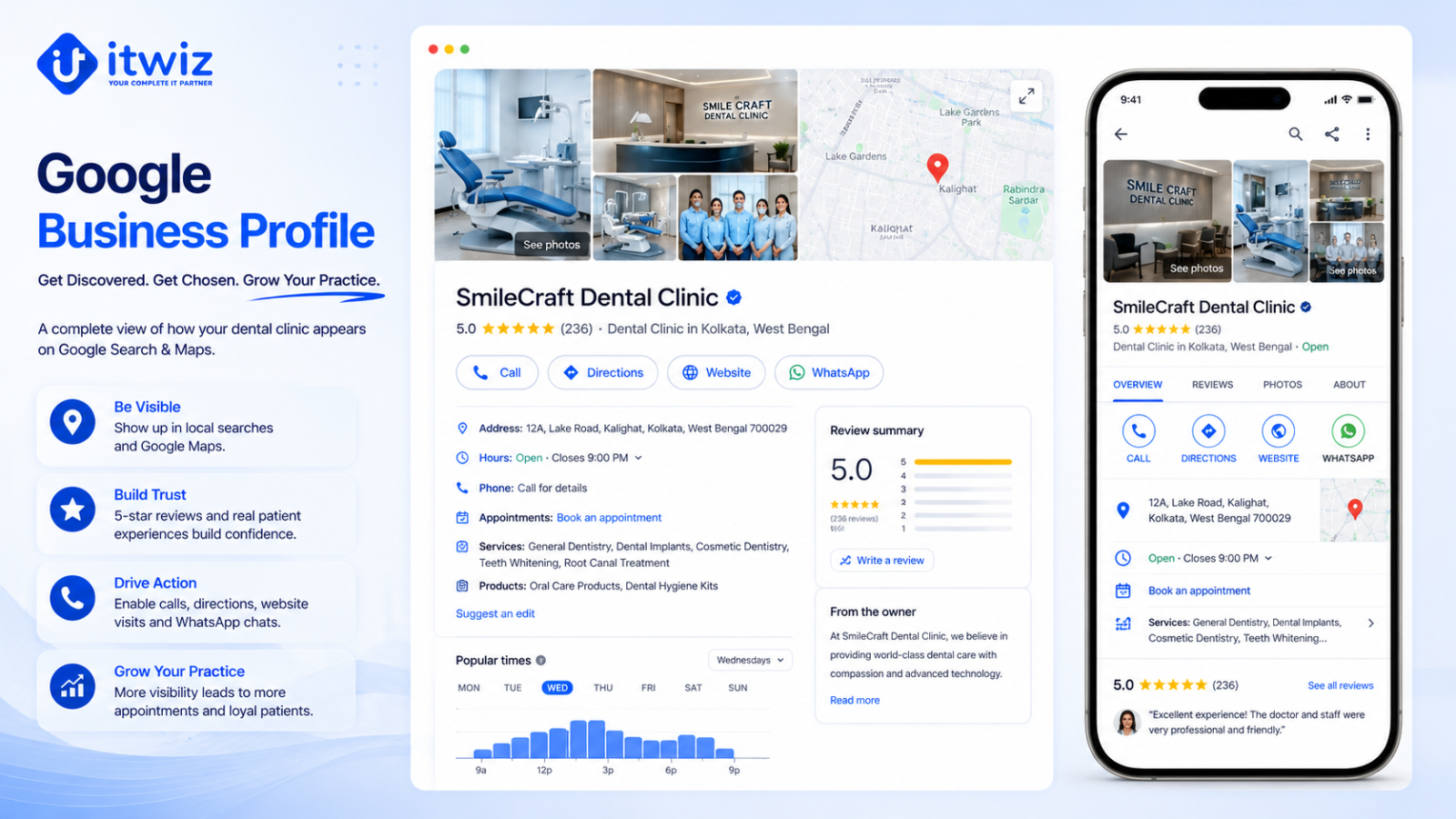
Prioritize Your Google Business Profile
If your dental clinic has not yet been verified on Google Business Profile, this should be one of your highest priorities. The platform is free to use and helps your clinic appear on Google Maps and local search results, making it easier for potential patients to find your contact details, operating hours, location, and patient reviews.Once verified, ensure that the login credentials are securely stored and accessible to authorized team members.
It is also important to select the most appropriate primary category, such as “Dentist” or “Dental Clinic,” as this influences the types of searches in which your practice may appear. A properly optimized Google Business Profile can significantly improve your clinic’s local visibility and patient acquisition efforts.
Choose Service Categories Strategically
-
List all relevant treatments available at your clinic in your Google Business Profile services section like,
-
Scaling and Polishing
-
Composite Bonding
-
Dental Implants
-
Teeth Whitening
-
Root Canal Treatment
-
Tooth Extractions
And other treatments.
Google uses your profile information to match your clinic with relevant searches, the content should be written with patients in mind. A clear and concise business description can help visitors quickly understand your services, expertise, and what makes your clinic unique.
2. High-quality photos of your reception area, treatment rooms, equipment, and team members help build trust and give patients a realistic view of your clinic before they visit. Authentic images are often more effective than stock photos because they create familiarity and reassurance, improve engagement, strengthen credibility, and encourage more patients to contact your clinic.
3. Keep Your Business Hours Accurate and Up to Date
Maintaining accurate business hours on your Google Business Profile is essential for providing a positive patient experience. Regularly update your operating hours, holiday schedules, and any temporary changes to ensure patients always have access to accurate information.
4. Use the Q&A section proactively by adding the questions patients actually ask about parking, payment options and whether procedures hurt and answer them yourself.
5. The most successful clinics make review requests a natural part of their post-appointment process. The front desk can say something like "Glad everything went smoothly. A Google review really helps us. I can send you the link now." Then they send the direct review URL via WhatsApp on the spot while the experience is still fresh.
6. Avoid offering incentives for reviews, as incentivized feedback may violate Google’s policies and negatively impact your profile.
Responding to Reviews is important
- Responding to every review whether positive or negative is very important.
- When responding to reviews, personalize your replies by referencing specific details from the patient’s experience rather than relying on generic thank-you messages.
- For reviews you should stay brief and composed, acknowledge the experience, avoid public argument and invite the patient to call directly.
- Prospective patients read your responses carefully as the reviews themselves. A measured response to a complaint builds confidence than ten unanswered five-star ratings.
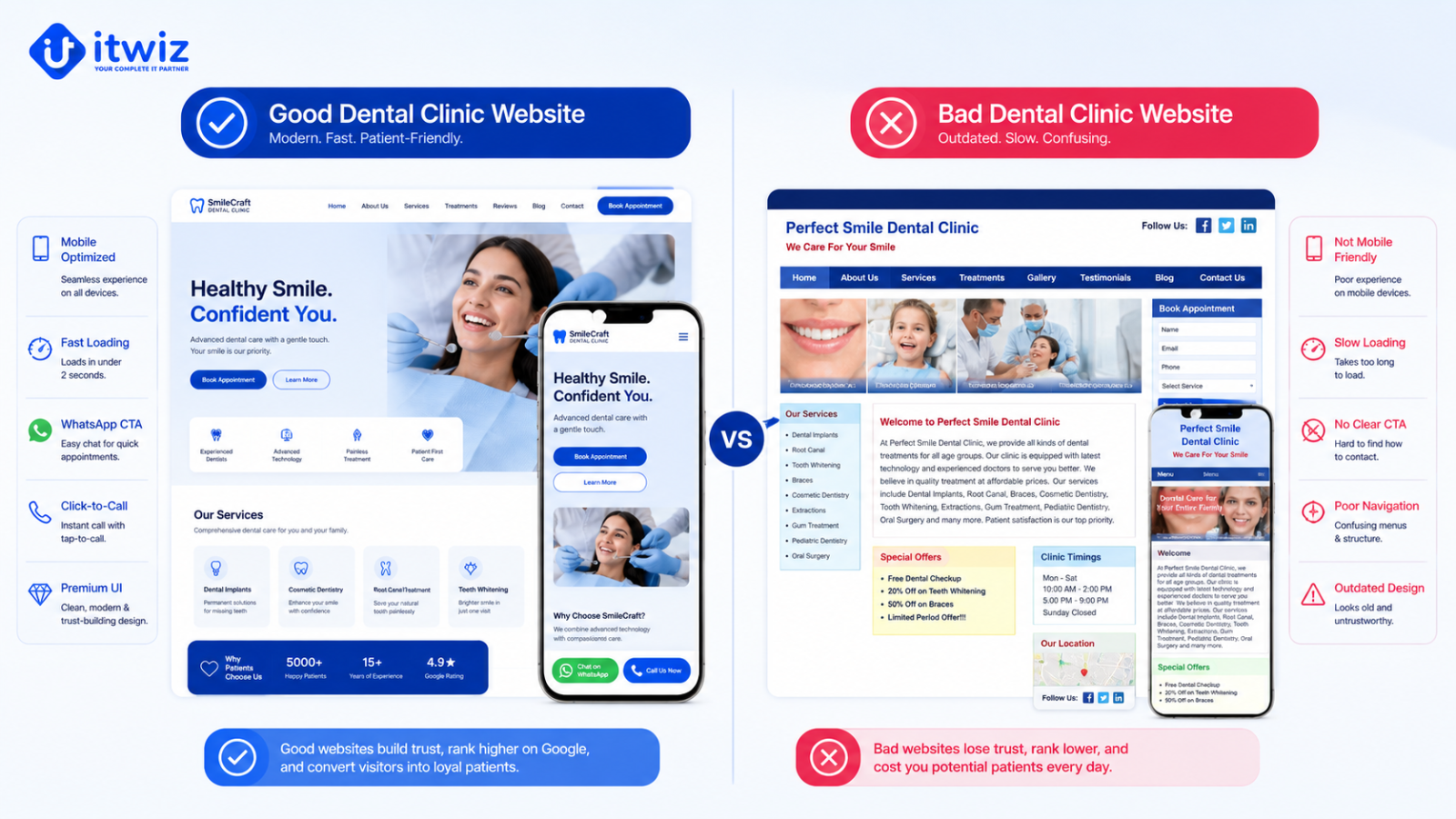
Website Optimisation is crucial for your clinic's presence
A dental clinic website needs to answer three questions within ten seconds: What do you do? Where are you? How do I contact you?
If a patient has to scroll or click to find any of these a meaningful percentage will leave.
You should run your site through Google PageSpeed Insights because a mobile score below seventy is actively costing you patients. A one-second delay in load time reduces conversions by seven percent.
On-Page SEO Basics are essential for your website
- Title tags should include the keyword and location such as "Dental Implants in Salt Lake, Kolkata. [Clinic Name]" and should be under sixty characters.
- Meta descriptions should be between one hundred and fifty to one hundred and sixty characters. Should give someone a concrete reason to click, not a keyword dump, a genuine patient-facing reason.
- Write content for patients first, focusing on their concerns and questions, while allowing keywords to be incorporated naturally.
Contact elements are crucial for converting patients
For dental clinics, the most effective conversion elements include a prominent click-to-call button, a WhatsApp chat option with a pre-filled appointment message, and a simple booking form that minimizes patient effort.
Make it easy for patients to contact you and gather clinical details later during their appointment. Treatment Pages and Location Pages are important for your website.
Each major service needs its page with content written for the patient actually considering those treatments, what it involves, how long it takes, what the realistic outcome is, roughly what it costs.
For clinics serving localities individual location pages multiply your rankable surface area.
Each must contain area-specific content, not a template with a different suburb name pasted in.
Content Marketing is a way to educate and build trust with patients
For two weeks, keep a record of the questions patients ask at reception, over the phone, or through WhatsApp. These real questions can provide many blog topic ideas based on what patients genuinely want to know.
By answering common patient concerns through your blog, you can create useful content that aligns with actual search behavior, making it easier for potential patients to find your clinic online.
You should cover every stage of the journey because most dental blogs only produce awareness content, general oral health tips that no one searches with intent to book.
The converting content sits at the consideration and decision stages, treatment comparisons, cost guides "what to expect at your first appointment" pages.
You should map your content calendar across all three stages so you are capturing patients wherever they are in the decision process.
You should prioritise topics with intent because "cost of dental implants in Kolkata" has meaningful search volume and very high purchase intent.
You should use Google Search Console to identify queries already bringing traffic at positions and build or improve pages to rank for those terms.
You should prioritise the intersection of patient need and commercial intent.
Educational Content With Honest Messaging is key to building trust with patients.
-
You should say something like "most patients find it more comfortable than they expected though individual experience varies" because "one hundred percent painless procedure" triggers scepticism from anyone who has had work.
Patients who arrive at a consultation already informed with expectations are more likely to proceed. The content is doing the consultation work for you.
-
You should connect content to conversion because a blog post about implants that ranks well should link directly to your implant treatment page, which should link directly to your contact or booking page.
-
Content that exists in isolation from the rest of the site generates traffic but not appointments.Internal linking creates the path from education to enquiry.
-
Online Reputation is crucial for your clinic because people do not trust claims that come from the business making them.
-
They trust claims from patients especially in a category like dentistry where anxiety is common and the stakes feel personal.
-
Volume and recency both matter, because a clinic with one hundred and eighty reviews collected over three years consistently outperforms one with twenty at the same average rating.
-
Volume signals that many patients have trusted you recency signals that the experience is current.
-
You should create an URL linking directly to your Google review page because after every successful appointment the front desk team member should send it via WhatsApp on the spot while the patient is still present and the positive experience is fresh.
-
Timing is everything because a patient who just saw their smile transformation is primed.
-
You should handle criticism without damaging the brand because you are not writing a response for the person who left the review. You are writing for the hundred prospective patients who will read it.
You should keep responses brief, acknowledge the experience, avoid arguments, and invite a direct conversation
A composed response to a complaint is often more reassuring to a patient than a string of five-star reviews with no evidence of how the clinic handles problems.
You should respond across every platform where your clinic is listed because those platforms are actively used for dental clinic research in Indian urban markets.
Justdial drives enquiry volume in cities and Facebook reviews appear in search results.
You should set up a Google Alert for your clinic name so you are notified whenever it appears online.
Paid Media is important for your clinic because it can help you reach patients.
You should use Google Ads and Meta Ads to reach patients who are searching for clinics, like yours.
Active Demand vs. Demand Generation
Google Ads captures patients who are already searching for dental care. Meta Ads introduces your services to patients who are not yet looking. Both are valuable, but they serve different stages of the patient journey. For clinics with limited budgets, Google Search campaigns for high-intent keywords should come before Meta Ads. Once that is converting reliably, Meta Ads can layer in for awareness and elective treatments.
Google Ads: Targeting Patients Ready to Book
- Target high-intent, treatment-specific terms: 'dental implants Kolkata,' 'invisalign cost near me,' 'emergency dentist open now.'
- Use phrase match or exact match — broad match keywords will match irrelevant searches and drain budget fast.
- Build a strong negative keyword list from day one.
- Set geographic targeting to your actual service radius, not the whole city.
- A clinic in Behala does not need to pay for clicks from patients in Dum Dum.
Meta Ads: Visual Treatments and Awareness
Instagram and Facebook Ads work well for treatments that benefit from visual demonstration — smile makeovers, clear aligners, veneers.
Real before-and-after results, captured with proper patient consent, consistently outperform stock imagery and graphic design.
Expect a longer lead-to-booking timeline from Meta than from Google Search, because the patient was not actively looking when your ad appeared.
Campaign Structure and Budget Management
-
Run separate campaigns for separate treatment categories.
-
Implant patients are not the same as orthodontic patients — different age range, different income level, different decision timeline, different messaging.
-
After 60 to 90 days, analyse geographic data:
-
Which pin codes are generating consultations?
-
Which pin codes are generating clicks that never convert?
-
-
Shift budget toward what is actually producing patients.
The Mistakes That Waste Budget
Sending paid traffic to the clinic homepage instead of a treatment-specific landing page is the single most expensive error in dental advertising.
Other common drains include:
-
No negative keywords.
-
Budgets too small to exit Google's learning phase (which requires approximately 50 conversions in a 30-day window).
-
No conversion tracking.
Without knowing which keywords and ads are generating actual appointments, you are optimising blind.
Social Media: How to Build Authority Without Depending on It
Instagram's Role in the Patient Journey
Instagram is rarely the first touchpoint for a new patient, but it is often the last thing they check before booking.
After finding your clinic on Google and reading reviews, patients will visit your profile to see what the clinic actually looks and feels like.
For cosmetic dental clinics specifically, Instagram plays a stronger role earlier in the funnel — a compelling smile transformation can create intent where none existed before.
Content That Builds Trust
The following consistently outperform stock images and generic tip graphics:
-
Real before-and-after case photos with consent.
-
The dentist explaining a procedure on camera in plain language.
-
Team introduction posts.
Patients respond to specificity: real cases, real people, real results.
A 60-second phone video of the dentist answering a common patient question builds authority faster than any professionally designed carousel.
Consistency Over Volume
Three to four quality posts per week, maintained consistently over six months, will build a more credible presence than daily posting for three weeks followed by silence.
Your social presence and your clinic should feel like the same brand:
-
Same tone.
-
Same values.
-
Same visual identity.
When a patient who followed you online walks in, the experience should feel like a natural continuation of what they already knew.
Connecting Social to the Rest of the System
Every post with a commercial intent should direct patients to your WhatsApp or booking page.
'Book a free smile consultation — link in bio' converts better than 'contact us.'
When running Meta Ads, your organic feed is the credibility check patients run before deciding to enquire.
A dead or generic feed undermines paid campaign conversion.
Your organic presence and your paid presence are working on the same prospective patient.
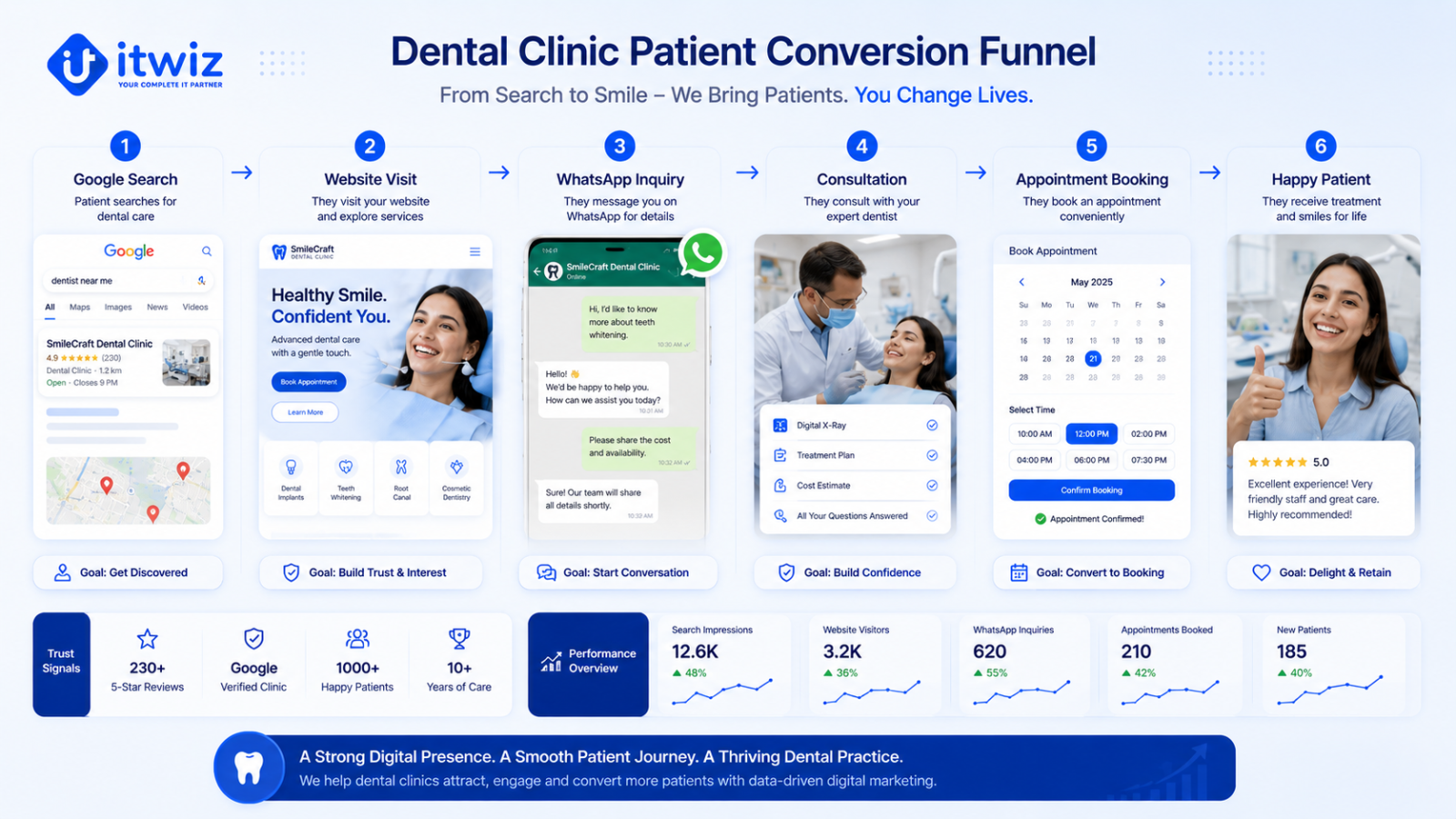
Patient Conversion: Turning Visits Into Booked Appointments
The Trust Elements That Remove Hesitation
Patients who reach your website but do not make contact are usually missing one of a handful of things:
-
Enough reviews to feel confident.
-
A photo and biography of the dentist they will see.
-
Transparency around what the first appointment involves and roughly what it costs.
-
A contact mechanism that does not feel like work.
These additions take a few hours to implement and can meaningfully shift the percentage of visitors who take the step of making contact.
Map the Journey, Find the Friction
Map the full path from first online encounter to booked appointment and identify where patients drop off.
The most common friction points include:
-
Landing on a homepage instead of the treatment page they searched for.
-
Not finding a contact button without scrolling.
-
Encountering a form with more than four fields.
-
Receiving no response to an enquiry within the same working day.
Each friction point is an opening for a competitor.
Response Speed on WhatsApp
A study published in the Harvard Business Review found the odds of converting a lead drop by 80 percent if the first response comes more than five minutes after the enquiry.
In India's urban dental market, this conversion happens on WhatsApp.
A patient who sends an enquiry and receives a personalised message with a specific appointment slot within ten minutes is far more likely to confirm than one who gets an automated acknowledgement two hours later.
Assign a specific person to manage enquiry response during clinic hours.
It is not glamorous, but it may be the single highest-return action in your entire operation.
Landing Pages for Campaigns
A landing page built for a specific campaign — dental implants, teeth whitening, clear aligners — should cover that service only.
It should include:
-
The key benefit above the fold.
-
A WhatsApp button or two-field form.
-
Treatment-specific social proof.
The difference in conversion rate between sending paid traffic to a homepage versus a purpose-built landing page is typically three to five times.
For the same advertising spend, proper landing pages generate three to five times more enquiries.
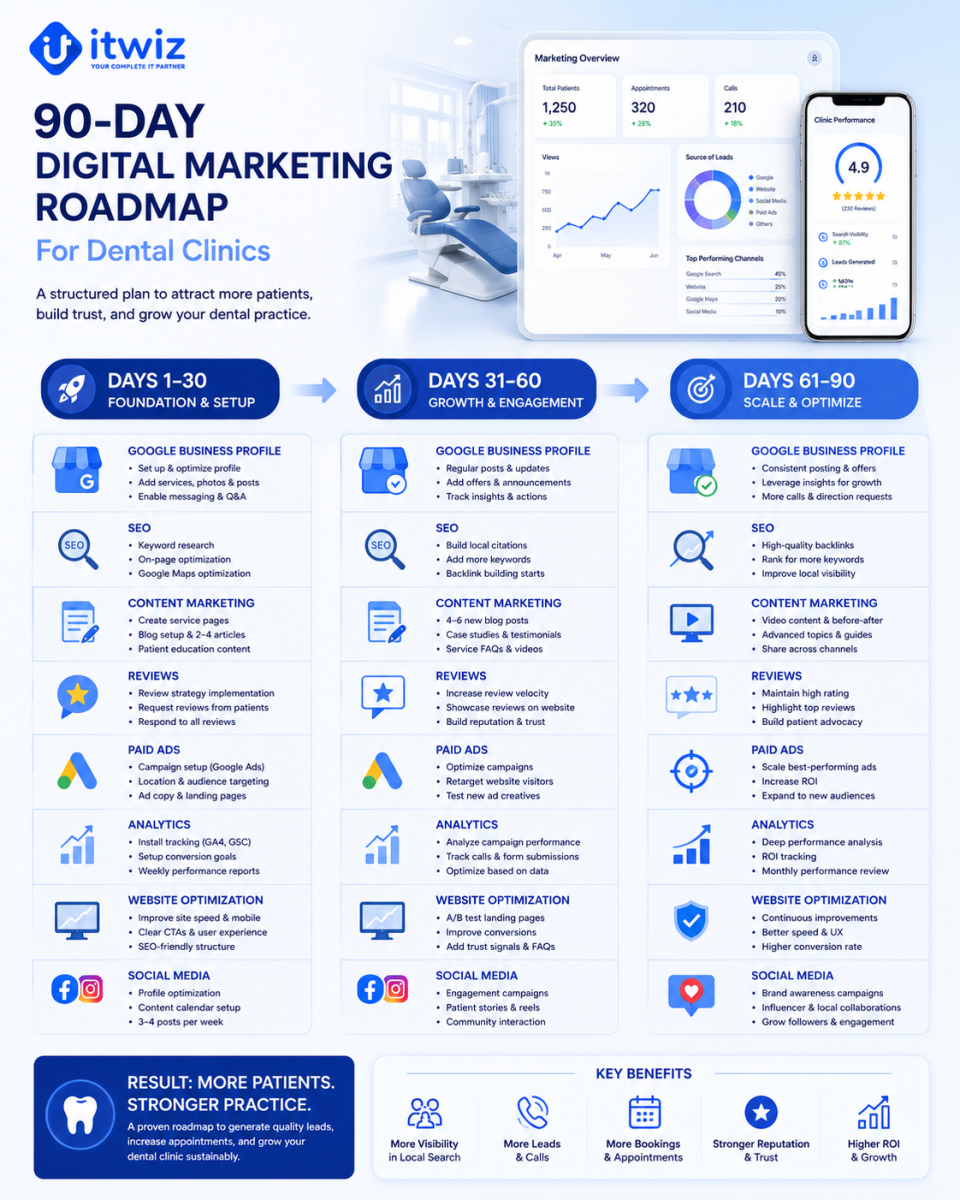
Start by Being Honest With Yourself
Search for your clinic name and the keywords people use to find you in a private browser.
-
Open your website on your phone and see how long it takes to find your contact number.
-
Check your Google Business Profile to make sure it is complete, has photos, and a good number of reviews.
-
Ask a colleague to try to book an appointment through your website as if they were a patient.
This exercise will take an hour and will show you the top things that need to be fixed right away.
Days 1 to 30
- Make sure your Google Business Profile is complete and verified.
- Start asking patients for reviews via WhatsApp, making it easy for them with a direct review link.
- Add a one-click call button and a WhatsApp widget to your website.
- Fix any problems that make your website slow or difficult to use on mobile phones.
- Ensure your clinic name, address, and phone number are consistent across Google, Practo, Justdial, and Facebook.
Days 31 to 60
- Create pages on your website for the top services that bring in the most revenue.
- Write four to six blog posts that answer questions people in your area are searching for.
- Use Google Search Console to identify what potential patients are looking for.
- Install Google Analytics 4 and configure it to track:
- Form submissions
- Click-to-call actions
- Launch a small Google Ads campaign for one high-value service with a budget of ₹500 to ₹1,000 per day.
Days 61 to 90 and Beyond
- Create location-specific pages for the areas your clinic serves.
- Review the performance data from your paid campaigns.
- Make decisions based on actual results, not assumptions.
- Ensure your team consistently asks patients for reviews after appointments.
- Plan to publish at least four new pieces of content every month.
- Track where every new patient is coming from each month.
Mistakes Dentists Make With Digital Marketing
Mistakes Dentists Make With Digital Marketing
1. Spending Money Without a Plan
A lot of clinics spend money on social media, Google Ads, and their website without knowing if it is actually bringing in new patients. This is not about not having money; it is about not measuring what works. Before you spend money on anything, you need to know what you want to achieve.
2. Using Social Media as the Main Way to Reach Patients
When we look at clinics that have been posting on Instagram for years, we ask how many new patients they got from it. The answer is usually very few.
Social media is good for building trust with patients who already know you. It does not usually bring in new patients like local search does. Focusing on Instagram while ignoring your Google Business Profile is like trying to get noticed in a place where patients are not looking to book appointments.
3. Not Focusing on Local Search Until It Is Late
A clinic that has been around for a while might find that new patients in the area cannot find them because a newer clinic has a better online presence.
Just because you are good at what you do does not mean people can find you. Local search is important for being visible; it is not something you can ignore.
4. A Website That Looks Good But Does Not Work
Give your website address to someone who has never seen it and ask them to find your phone number on their phone.
If it takes more than 10 seconds, your website has a problem. Your website should be designed to help patients find and contact you, not just to look good.
5. Creating Content That Does Not Help Patients
Posting about things like equipment or team birthdays does not help patients and does not bring in new ones.
Every page on your website should be there because it answers a question patients have. If your content does not do that, it is taking up space that could be used for something more valuable.
6. Making Claims That Do Not Build Trust
Saying things like "100 percent painless" or "guaranteed results" can make patients distrust you.
Being honest and clear about what you do and what patients can expect builds trust rather than making big promises.
Build a System and Keep It Going
The Key Parts That Help You Grow
Digital marketing works best when all of its components support one another.
-
Search visibility and a well-maintained Google Business Profile help patients discover your clinic.
-
A fast, user-friendly website and quick responses to enquiries turn visibility into appointments.
-
Content marketing and reputation management build the trust needed for conversion.
-
Paid advertising accelerates growth once the fundamentals are in place.
Remove one piece, and the entire system becomes less effective.
Where to Start
If your clinic is not growing, do not immediately add another marketing channel.
Identify the actual problem first.
-
Patients cannot find you? Focus on local SEO and your Google Business Profile.
-
Patients find you but do not enquire? Improve your website experience and trust signals.
-
Patients enquire but do not book? Review your response times and follow-up process.
These problems can be solved through better systems and execution—not simply by spending more money.
If all these steps sounds tedious to you and you don't have much time to look into marketing becasue as a dentist you are occupied in treating your patients then IT Wiz Infotech can help you in managing your digital presence online because we have more than 10+ years of experince in managing marketing for dental clinics and we are regarded as the best digital marketing agency for dentists in India and also internationally and cater to countries like USA, UK, Europe, Australia dental clinics or dentists.
Frequently Asked Questions (FAQs)
What is the best digital marketing strategy for dentists?
Keep it simple.
Start with your Google Business Profile. Ensure your website is capable of converting visitors into patients. Then add SEO and paid advertising for high-value treatments.
Social media and content marketing support the process, but they should not be the primary focus.
Most dental clinics achieve better results by focusing on patients who are already searching for a dentist.
Does local SEO really work for clinics?
Yes, it does.
Local SEO targets people who are actively searching for a dentist nearby.
They do not need to be convinced they need treatment—they simply need to find the right clinic.
Results usually begin appearing within three to six months, so patience is important.
Can Google Business Profile actually bring in patients?
Absolutely.
A well-maintained profile appears prominently in local searches and allows patients to call or message your clinic directly.
The clinics that benefit most are the ones that keep their profiles updated with reviews, photos, and accurate information.
Should dentists invest more in SEO or paid ads?
It depends on your goals.
-
Paid ads generate enquiries quickly, but they require ongoing investment.
-
SEO takes time to build momentum, but it can generate long-term traffic without paying for every click.
The strongest strategies combine both: paid ads for immediate patient acquisition and SEO for sustainable growth.
Which social media platform works best for dentists?
For aesthetic and cosmetic dental clinics, Instagram tends to perform best because before-and-after transformations resonate strongly.
Facebook can still be effective for reaching local audiences.
Remember, social media is generally better at building trust than generating entirely new patient demand.
What is not allowed in dental marketing in India?
Avoid making guarantees that cannot be supported and avoid misleading patients.
Incentivised reviews can also create compliance issues.
The Dental Council of India provides guidance, and consumer protection regulations apply as well.
The safest approach is simple: be honest and transparent about what patients can expect.
How long does it take to see results?
-
Paid search: Often within one week.
-
Google Business Profile improvements: Usually within a few weeks.
-
Local SEO: Approximately three to six months.
-
Content marketing: Around six months to one year.
Start with one priority area, execute consistently, and build from there.
How do you know if digital marketing is actually generating patients?
The simplest approach is often the most effective.
Ask every patient how they found your clinic and record the answer consistently.
What gets measured gets improved.
Prepared by IT WIZ — Digital Marketing for Healthcare and Wellness.